
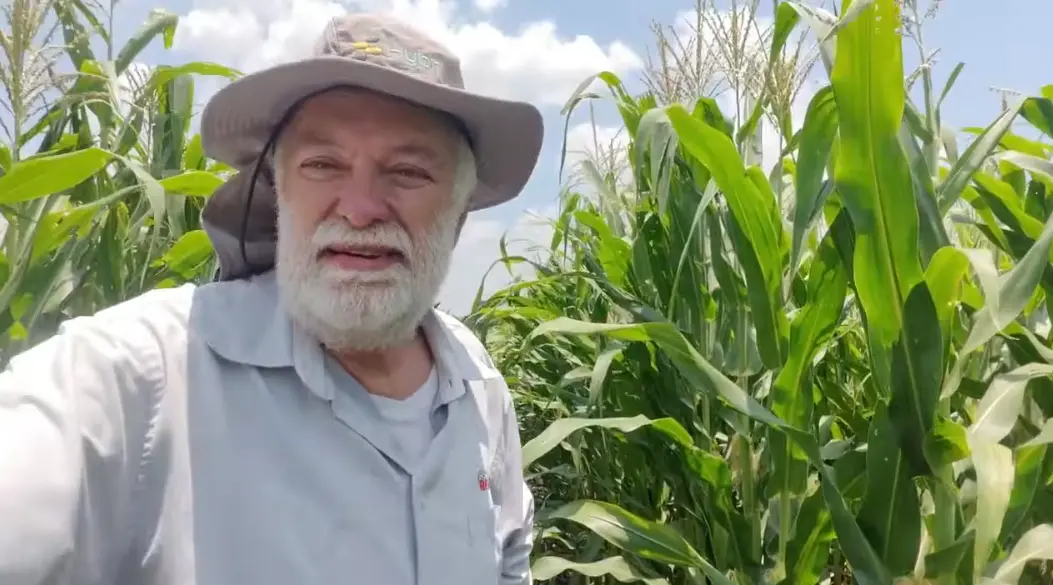
El Salvador is undergoing one of the most ambitious agricultural transformations in its modern history: the nation is working toward producing 100% of its maize and beans by 2029, significantly reducing — and eventually eliminating — dependence on imports.
This national effort, led by the government and supported by experts, combines modern technology, new genetics adapted to local conditions, and the most intensive agronomic training program ever implemented in the country.

How a Chance Connection Triggered a National Transformation
The origins of this shift trace back to July 2022, when Óscar Domínguez — then a technician at the Ministry of Agriculture — began conversations with Ernesto Cruz, the Mexican agronomist who holds the Guinness World Record for producing more than 44 tons of maize per hectare.
Domínguez later described this moment publicly, recalling that these talks marked “the beginning of a gigantic step that El Salvador would take in maize production.”
From there, the government began incorporating high-tech agricultural machinery, specialized technical assistance, and a new production model developed by ATIDER, the organization led by Cruz.
The first demonstration plots at CENTA showed highly promising results, inspiring the creation of a Salvadoran team trained directly in high-yield maize techniques. Those specialists then trained young agronomists who would participate in nationwide trials.
Ernesto Cruz’s First Visit: Shock and Opportunity
In a video published by Cruz, he described his first technical visit to El Salvador in August 2022. What he found was both surprising and revealing:
- He estimated that plant population density in the field he inspected “did not exceed 30,000” plants per hectare.
- He stated that the production system used in the country was “a system of production from a thousand years ago, and it is still used.”
But the visit was not only about limitations. He highlighted the country’s enormous natural advantages:
- “This is a natural greenhouse,” he said.
- “There are never frosts.”
- Temperatures “do not exceed 38 degrees.”
- Annual precipitation is “between 1,900 and 2,300 ml.”
- Soils are volcanic, slightly acidic, and “very fertile.”
These conditions, he noted, are ideal for high-performance agriculture — but the missing ingredient was modern technique and technology.
The Meeting With President Bukele
Cruz later recounted his first meeting with President Nayib Bukele. The president expressed a clear objective: achieving national food self-sufficiency, particularly in maize and beans.
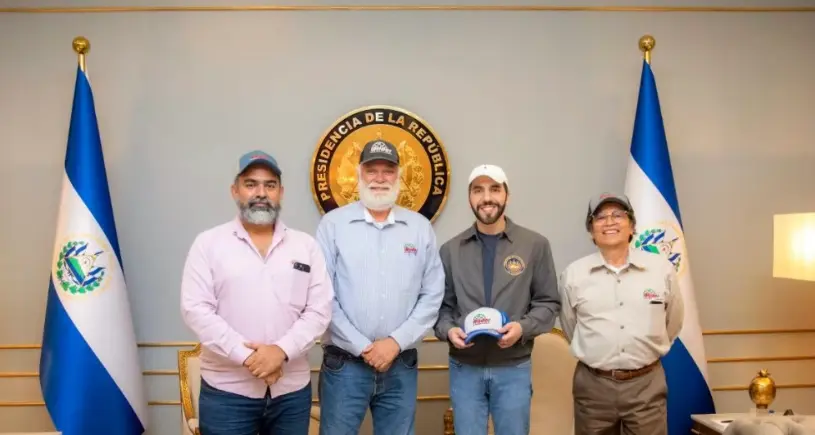
Bukele asked whether El Salvador could reach 6 tons of maize per hectare.
Cruz replied no.
Then 5 tons?
“No.”
Four?
“Impossible.”
Instead, Cruz insisted that the starting point should be 10 tons per hectare — a radical jump from the country’s traditional yields of 2.6 to 3 tons per hectare.


Developing Local Genetics and New Technology
In April 2025, Cruz stated that the team was now advancing a crucial element of the long-term strategy:
developing maize genetics specifically adapted to El Salvador’s tropical conditions.
As he explained, “What we are doing here is developing genetics for the farmers and the conditions of the Republic of El Salvador… the vision that guides us is that President Bukele set the goal of achieving self-sufficiency in maize and beans for El Salvador.”
This includes genetics for maize grain, maize elote, and maize silage — all necessary for a fully integrated agricultural system.
Pilot Tests and the First Major Results
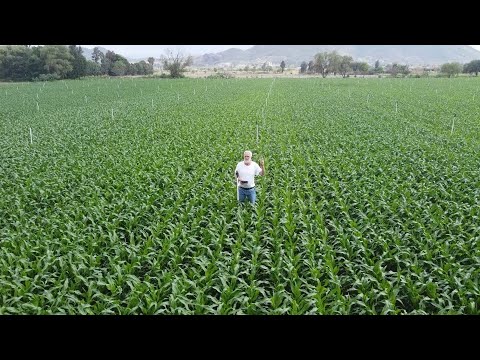
By early 2023, the government launched extensive pilot programs using:
- pneumatic planters,
- improved tractors and implements,
- drones,
- new harvesters,
- and teams of trained agronomists.
According to Domínguez, these pilots covered more than 500 manzanas across cooperatives and independent producers.
The results were striking:
They exceeded the national average, doubled yields in most areas, and reached nearly 15 tons per hectare, all without using transgenics.
These results demonstrated that El Salvador’s yield ceiling was dramatically higher than previously thought.
More Than 10,000 Manzanas of Maize Officially Seeded
By late 2025, the government officialized the sowing of more than 10,000 manzanas of maize nationwide.
Although the announcement did not detail every technical component, it is widely understood that these lands will incorporate:
- the techniques learned with ATIDER,
- new machinery,
- modern planting densities,
- improved genetics,
- and continuous technical supervision.
If the same knowledge applied in the pilot plots is implemented at scale, the country could leave behind the old yields of 2.6–3 tons per hectare and progressively approach high-performance levels.

The 2029 Goal: A National Mission
Although Cruz originally mentioned 2028 as the target during a 2024 interview, he later clarified in 2025 — through a program presentation on his YouTube channel — that the official objective is now to reach full maize and bean self-sufficiency by 2029.
The program objectives begin with:
- Self-sufficiency in maize grain and beans by 2029
- Efficiency improvements in maize elote and maize silage
With new genetics, trained personnel, mechanized planting, and tens of thousands of manzanas already included in the plan, the country is positioning itself to meet — or even surpass — this goal.

Please follow us on X!
Follow @ElSalvadorENx