
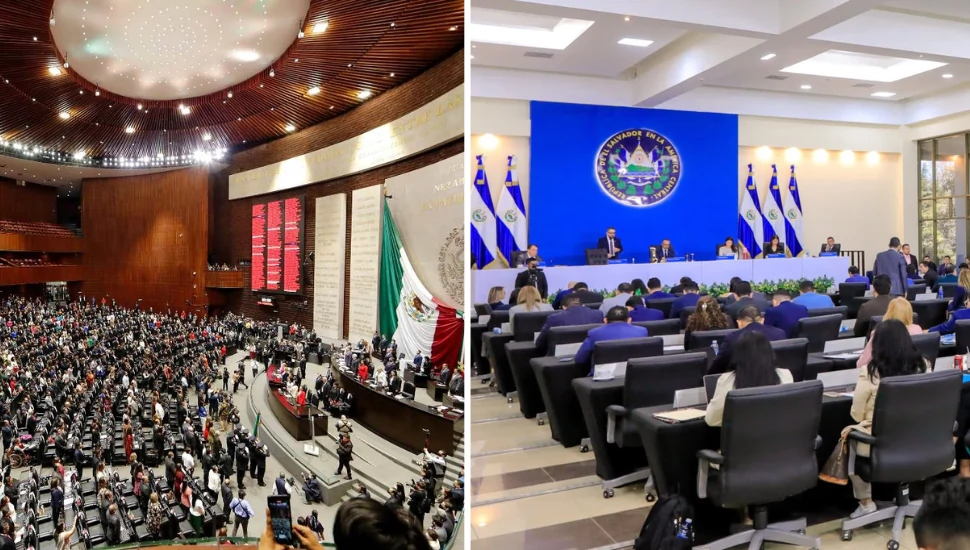
In times of political uncertainty, constitutions act as the core defense mechanism of a nation. They’re not just documents — they’re shields, foundations, and limits. That’s why anyone considering relocating, investing, or even just observing Latin America should ask: How solid is the constitution of each country? How easy is it to change, manipulate, or bypass it?
This post compares the constitutional solidity of Mexico and El Salvador — two countries geographically close, but constitutionally far apart.
🧱 What Makes a Constitution “Solid”?
A solid constitution is one that:
- Requires broad consensus for reform.
- Includes unchangeable clauses protecting the government’s core structure.
- Is designed to prevent authoritarian overreach or ideological hijacking.
- Remains resistant even during political majorities or regime shifts.
Let’s compare Mexico and El Salvador based on that.
🇸🇻 El Salvador: A Constitution Forged in Conflict
El Salvador’s current constitution was drafted in 1983, in the midst of a brutal civil war. The far-left guerrilla forces (later known as the FMLN) refused to participate in the constitutional process and chose instead to continue the armed conflict.
As a result, the constitution was intentionally designed to resist radical ideological takeovers. It included:
- A double legislature requirement: reforms had to be approved by one elected assembly and ratified by the next (after new elections), making hasty changes nearly impossible.
- A two-thirds majority needed for ratification.
- Unchangeable clauses (known as cláusulas pétreas) that explicitly prohibit changes to the system of government, presidential term limits, and the country’s territorial integrity.
These protections worked… From 2009 to 2019, the socialist party (FMLN) couldn’t amend a single article — not for lack of intent, but due to structural limits and firm opposition.
📊 In total, from 1983 to 2024:
- Only 14 constitutional reforms were fully ratified.
- 39 other proposals were approved but never ratified, blocked by the rigidity of the system.
This was not a coincidence. It was by design.
🧱 The 2025 Reform: A Shortcut with a Stronger Lock
In 2025, under President Nayib Bukele and the supermajority held by his party (Nuevas Ideas), the Legislative Assembly reformed Article 248 of the Constitution.
🔧 What changed?
- A new pathway was added: now, a constitutional reform can be approved and ratified within the same legislature, but only if 75% of deputies support it.
- The original method (two different legislatures and 66% ratification) remains intact.
- No changes were made to the unchangeable clauses — the system of government, presidential alternation, and territorial integrity remain untouchable.
This means:
✅ Yes, the process is now faster.
❌ But it’s not easier — it now requires more votes (75%), making it arguably more rigid and demanding.
So, if El Salvador’s constitution was reinforced granite, now it has a secure steel hatch built into it: a second access point that only opens with an even stronger key.
🇲🇽 Mexico: A Constitution in Constant Motion
Mexico’s Constitution, enacted in 1917, is historically significant but incredibly flexible.
It has been amended over 700 times, often in response to changing political agendas. That’s partly due to:
- A simpler amendment process: 2/3 of Congress + approval from 17 of 32 state legislatures.
- No requirement for approval by a future legislature.
- No unchangeable clauses — even fundamental aspects of government can be altered.
Since MORENA, a socialist party aligned with the São Paulo Forum, came to power in 2018, constitutional reforms have accelerated. Proposed and implemented changes have included:
- Transforming security forces (e.g., the militarization of the National Guard).
- Attempting judicial reforms, including popular election of judges — a move that could severely politicize the judiciary.
- Electoral and energy system overhauls.
🪵 Mexico’s constitution is more like treated wood: strong enough for structure, but soft enough to cut, shape, or burn when needed — especially if a political majority exists.
🧱 Side-by-Side: Two Different Foundations
| Feature | 🇸🇻 El Salvador | 🇲🇽 Mexico |
|---|---|---|
| Year of Enactment | 1983 | 1917 |
| Core Purpose | Block ideological takeovers | Post-revolution restructuring |
| Requires Two Legislatures? | Yes (still an option) | No |
| Supermajority Needed? | Yes – 66% or 75% | Yes – 66% + state support |
| Clauses That Cannot Be Changed | Yes (gov’t, presidency, territory) | No |
| Number of Full Reforms Ratified | 14 (1983–2024) | 700+ |
| Number of Proposals Blocked | 39 | — |
| Resistance to Socialist Takeover | High | Low |
Why It Matters for Relocation and Stability
Mexico, due to its size and proximity to the U.S., often attracts people looking to relocate or invest in Latin America. But its high constitutional flexibility allows each new federal majority to reshape the system significantly — and quickly.
El Salvador, despite being smaller, has a more stable and harder-to-bend constitutional core. Even under a popular and powerful president, reforms require either a new legislature or three-quarters support — a high bar that makes whimsical or ideological rewrites unlikely.
⚖️ Final Thought
When choosing where to live, invest, or build, don’t just look at short-term promises or who’s currently in power. Look at the walls, not the wallpaper. A country’s constitution is its foundation — and its guardrail.
- 🇲🇽 Mexico’s foundation is flexible but vulnerable to rapid political redesign.
- 🇸🇻 El Salvador’s foundation is rigid, cautious, and still resistant to ideological pressure — even after internal reform.
📝 A Final Note
While this site focuses primarily on El Salvador, we do not claim it is the only solid option in Spanish-speaking Latin America.
However, due to its geographic proximity to Mexico (they’re separated only by Guatemala), and the fact that Mexico is currently undergoing deep ideological and institutional change, we found this comparison especially relevant to help readers evaluate which constitutional structure offers more long-term certainty and stability.
If you’re weighing your options in Latin America, understanding which systems are built on rock and which are built on sand can help you make more informed, grounded decisions.
Please follow us on X!
Follow @ElSalvadorENx