
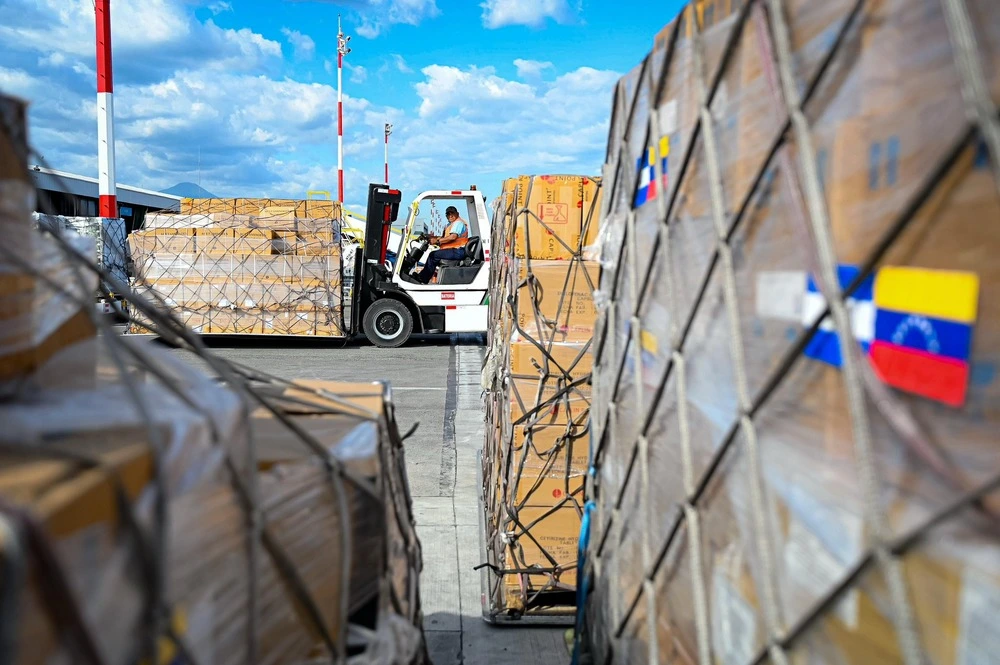
In one of the largest humanitarian operations mounted by a single country following the double earthquakes that struck Venezuela on June 24, El Salvador has completed the deployment of six aircraft carrying some 300 rescue workers and approximately 150 tons of equipment, machinery and supplies.
The mission, initially announced as three planes, was expanded after Salvadoran personnel on the ground assessed the needs firsthand.
President Nayib Bukele confirmed the departure of the sixth and final plane on the night of June 26, writing on X: “The sixth plane from El Salvador has left for Venezuela. We continue to add efforts to support our Venezuelan brothers and sisters. Strength, Venezuela.”

🚨 What the aid includes
Personnel
The Salvadoran contingent is made up of members from the Fire Department, Civil Protection, the Armed Forces, the Ministry of Health, the National Civil Police, the Red Cross and Comandos de Salvamento — all trained in urban search and rescue operations.

Heavy machinery
Beyond rescue teams and medical staff, El Salvador included heavy machinery and specialized tools in its shipments to help clear rubble more efficiently.
The equipment has been operational on the ground since early in the mission, assisting in the removal of debris from collapsed buildings across the hardest-hit areas of Caracas and La Guaira.
Supplies for those affected
The cargo also includes medication, food and basic necessities for the thousands of people displaced or left homeless by the earthquakes. According to ContraPunto and Prensa Latina, the shipments cover both rescue operations and immediate humanitarian relief.
🔍 Rescue efforts on the ground
Salvadoran teams have participated in several rescues of survivors trapped under the rubble. It is important to note that these rescues are often the result of coordinated teamwork — Salvadoran personnel working alongside local first responders, volunteers and teams from other countries.
In many cases, multiple groups converge at the same site, making it a shared effort rather than the work of a single team.
While exact numbers of survivors rescued specifically by Salvadoran personnel have not been officially consolidated at this stage — four days after the disaster — media reports have documented several rescues where Salvadoran teams played a key role.
During search operations, animals trapped in the rubble have also been found and rescued by different teams working in the affected zones.
Authorities have cautioned that the number of missing is still high and rescue operations remain ongoing around the clock.

📊 El Salvador’s contribution in context
| Category | Details |
|---|---|
| Aircraft deployed | 6 (all arrived between June 25–26) |
| Personnel sent | ~300 firefighters, paramedics, military, police and rescue specialists |
| Total cargo weight | ~150 tons (machinery, tools, medicine, food, supplies) |
| Heavy machinery | Included and operational on the ground since early in the mission |
For perspective, other nations have also responded significantly:
- Mexico sent approximately 261 personnel (240 Army, 11 Air Force, 10 National Guard) with 18 search dogs and initially 7.1 tons of tools and medical supplies, with a second C-130 flight carrying an additional 12 tons announced (Reporte Índigo, citing Sedena).
- The United States deployed the largest logistical operation overall, including urban search and rescue teams from Virginia and Los Angeles, two Navy vessels, C-17 aircraft and Pentagon coordination on the ground, along with over 6 tons of medical supplies reported so far.
- Switzerland dispatched 80 rescuers with 18 tons of equipment.
- Colombia sent 63 rescue specialists and 12 tons of humanitarian aid.
- Spain mobilized approximately 97 personnel from the UME and Madrid fire brigade, along with a field hospital.
Each country has contributed according to its capacity. El Salvador’s effort stands out for its volume relative to the country’s size and for including heavy machinery — a critical resource in the early stages of a seismic disaster.
🤝 International coordination
El Salvador’s mission is part of a broader global response coordinated by the UN Office for the Coordination of Humanitarian Affairs (OCHA), which has reported at least 17 countries mobilizing rescue teams and medical assistance, with over 25 international teams and close to 1,000 foreign personnel deployed in the most affected areas.
As search efforts continue past the 72-hour mark, Salvadoran teams remain on the ground, working shoulder to shoulder with personnel from other nations in the race to find survivors.
Please follow us on X!
Follow @ElSalvadorENx