
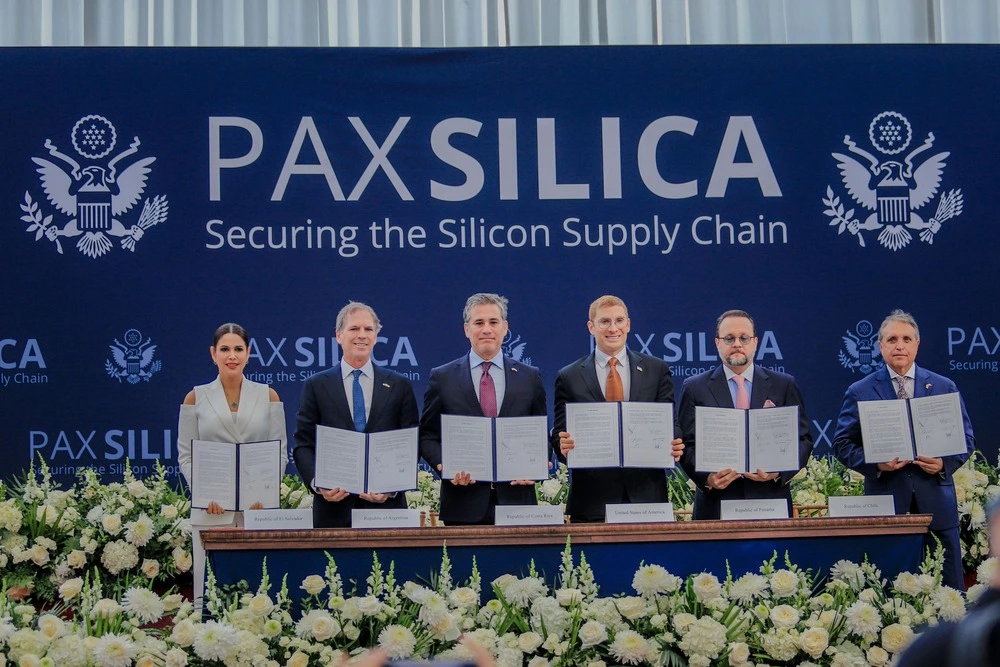
On June 25, El Salvador became a signatory of Pax Silica, the U.S.-led initiative focused on semiconductor and AI supply chains. This post explains what that means in practical terms.
What Pax Silica Is
Pax Silica is a diplomatic initiative launched by the U.S. State Department in December 2025. Its stated goal is to coordinate among allied countries on:
- Semiconductor manufacturing and supply chains
- AI infrastructure and computing capacity
- Critical minerals and rare earth elements
- Data center development and connectivity
It is not a treaty. It is not a trade agreement. It is a non-binding declaration of intent to cooperate. More than 30 countries have signed it, including Japan, South Korea, India, the UK, Australia, and several European and Latin American nations.
Why El Salvador Joined
El Salvador does not manufacture semiconductors. It does not mine rare earth minerals. Its tech sector, while growing, is small by international standards.
The government’s stated rationale is that membership positions the country to attract investment in data centers, tech infrastructure, and talent development. The U.S. has described El Salvador as a reliable partner in the region.
There is no indication that El Salvador was offered specific financial incentives or projects as a condition of joining.

What Membership Actually Means
What changes immediately: Nothing. No funds are transferred. No projects are guaranteed. No binding obligations are created.

What changes potentially:
- El Salvador is now included in diplomatic conversations about tech supply chains
- It may have priority access to U.S.-backed investment consortia, including a $250 million fund announced earlier this year for critical minerals and energy
- It can participate in working groups and knowledge-sharing programs
- It may become a more attractive location for companies looking to diversify their supply chain footprint in Latin America
What does not change: El Salvador’s domestic infrastructure, workforce skills, and regulatory environment remain the same. These are the factors that will determine whether any investment materializes.
What to Watch For
If membership leads to concrete outcomes, they will likely appear in these areas:
| Area | What to look for |
|---|---|
| Data centers | Announcements of new facilities by major tech companies |
| Energy | Investment in geothermal or other power infrastructure to support tech projects |
| Education | Programs for training engineers, developers, and technicians |
| Investment | Capital flows from member countries into Salvadoran tech ventures |
If none of these materialize within 12-24 months, the membership will have been largely symbolic.

A Realistic Assessment
Joining Pax Silica is a diplomatic step. It signals alignment and ambition. It does not, by itself, change economic realities.
The value of membership will depend entirely on what El Salvador does next — in education, infrastructure, regulation, and investment promotion. Pax Silica opens a door. Walking through it requires work that has not yet been done.
For now, the most accurate description is: El Salvador is now part of a conversation about the future of tech supply chains worldwide. Whether that translates into tangible benefits remains to be seen.
Please follow us on X!
Follow @ElSalvadorENx