

El Salvador and Costa Rica have taken a historic step by launching Americas Shield, a new bilateral initiative designed to confront the growing threat of transnational criminal networks.
Presented jointly by President Nayib Bukele and President Rodrigo Chaves, the initiative establishes a coordinated security framework meant to match the reach and sophistication of the criminal organizations operating across Latin America.
The concept of a unified regional defense against organized crime is not entirely new. President Bukele had already brought up the idea during his official visit to Costa Rica last year, where he emphasized the need for countries to move from isolated efforts to a shared regional strategy.

According to both governments, this new visit by President Chaves to El Salvador—after months of preparation and refinement of the proposal—marks the moment when the long-discussed vision becomes a concrete and operational initiative: the creation of the Americas Shield.
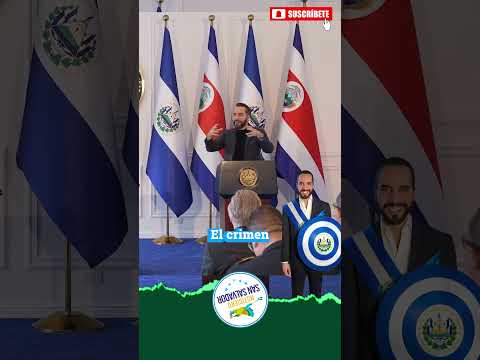
During today’s announcement, President Bukele reiterated the core challenge: criminals operate across borders as a coordinated network, while governments still act independently. As he stated:
“Crime has no borders. Crime does not stop because a border is there. It acts transnationally, it finances itself transnationally, it coordinates itself transnationally.”
He highlighted that the drug trade alone demonstrates this dynamic:
“Drugs produced in one country are transported through another, processed in another, packaged in another, and sold in yet another. Crime works as a single coordinated network—but countries do not.”
Bukele explained that this discrepancy gives criminal groups a structural advantage. Americas Shield seeks to reverse that advantage by creating direct, practical cooperation between El Salvador and Costa Rica as the starting point for a broader regional alliance.
The initiative is explicitly open to other countries that share the same goals and are willing to join.
He affirmed that the effort is not just about sharing experience, but developing a unified operational response:
“this strategy that begins with two (countries), but is open to governments that think alike and want the best for their people, and who want to eliminate the international criminality that plagues all of Latin America.”
President Chaves emphasized that Costa Rica sees Americas Shield as an opportunity to strengthen its security posture and collaborate on threats that clearly transcend national boundaries.
Although El Salvador has successfully dismantled the criminal structures that once dominated its territory, Bukele stressed that the country remains surrounded by regional challenges. Cooperation, he said, is essential to preserve national security gains and extend stability beyond its borders.

With Americas Shield, both nations aim to lay the groundwork for a new regional security architecture—one capable of confronting transnational crime with the same unity, coordination, and reach that criminal networks have long used throughout the Americas.
![Official Visit: President of Costa Rica Visits El Salvador [December 2025]](https://elsalvadoren.com/wp-content/uploads/President-of-Costa-Rica-visits-El-Salvador-650x488.webp)
Please follow us on X!
Follow @ElSalvadorENx