
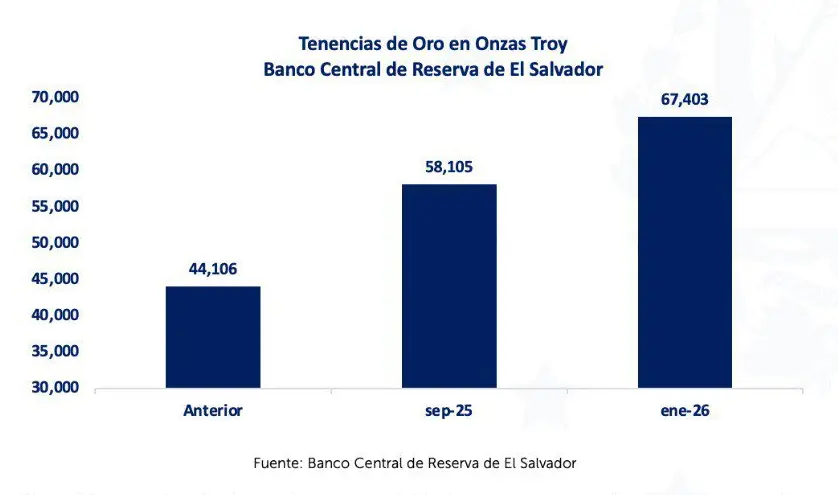
In the middle, it shows the gold purchase carried out in September 2025, and on the right, the gold purchase made in January 2026.
The Central Reserve Bank of El Salvador (BCR) has announced a new gold acquisition valued at USD $50 million, reinforcing efforts to strengthen and diversify the country’s international reserves.
This purchase follows a previous gold acquisition of approximately USD $50 million in September 2025, making these the first two gold purchases carried out by the BCR since the 1990s. Together, they represent a clear shift in reserve policy and a renewed institutional focus on gold as a strategic asset.

For decades, gold gradually disappeared from El Salvador’s reserve strategy. Under administrations led by other political parties, large portions of the country’s gold holdings were sold off, leaving gold to represent only about 7% of total reserves.

This long period of divestment significantly reduced the country’s exposure to an asset traditionally viewed as a long-term store of value and a hedge against financial instability.
The most significant reduction occurred under socialist-led governments, which liquidated approximately 80% of the gold reserves El Salvador held at that time. These decisions fundamentally reshaped the structure of national reserves and pushed gold into a marginal role within the country’s financial framework.
The recent back-to-back gold purchases signal a strategic reversal. Gold is once again being positioned as a core reserve asset, reflecting a broader effort to rebuild long-term financial resilience, diversify risk, and restore balance to El Salvador’s reserve composition.
In parallel with this renewed focus on gold, El Salvador continues to expand its national Bitcoin reserve strategy. The country has adopted a policy of regular Bitcoin accumulation—buying Bitcoin on an ongoing basis (frequently reported as daily purchases)—as part of a long-term sovereign reserve model.

Bitcoin has been formally integrated into the country’s reserve framework as a strategic digital asset, rather than a speculative instrument.
Together, these policies reflect a dual-track reserve strategy: strengthening traditional safe-haven assets like gold while simultaneously building exposure to emerging digital reserve assets such as Bitcoin.

This approach represents a fundamental transformation in how El Salvador manages national reserves—moving away from a narrow, conventional model toward a diversified structure designed for long-term stability, resilience, and sovereignty in an evolving global financial system.
Source: https://x.com/bcr_sv/status/2016980079742439612Please follow us on X!
Follow @ElSalvadorENx