
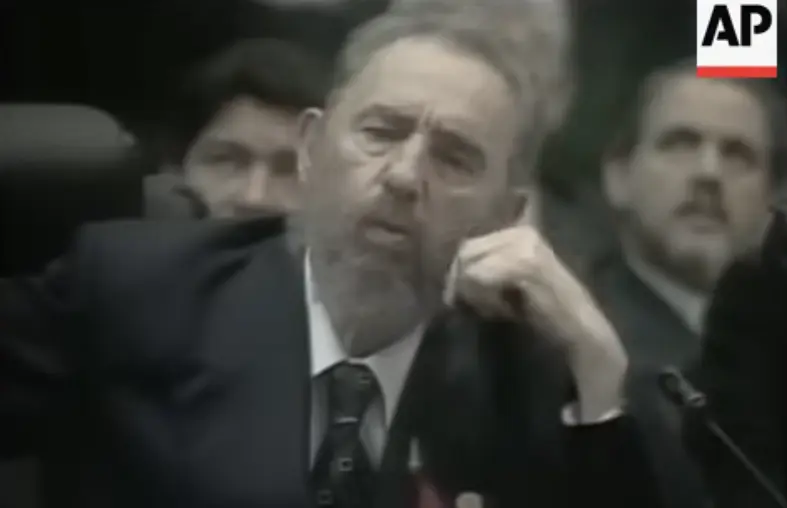
In the year 2000, during the Ibero-American Summit held in Panama, an unexpected verbal clash erupted between Fidel Castro, the long-time dictator of Cuba, and Francisco Flores, then president of El Salvador.
The exchange remains one of the most striking and little-known moments in modern Latin-American diplomacy.
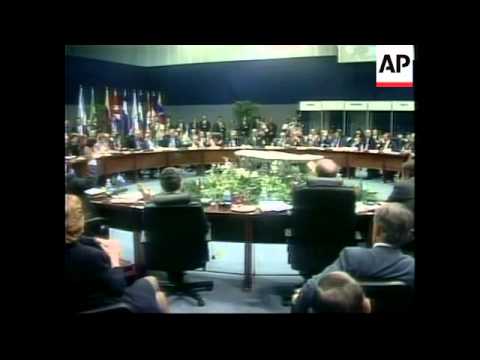
The summit brought together leaders from across the Spanish- and Portuguese-speaking world — among them Hugo Chávez of Venezuela, Ernesto Zedillo of Mexico, and presidents from nearly every country in Latin America and the Iberian Peninsula.
It was meant to be a routine meeting focused on cooperation and development, but it quickly became memorable for a confrontation that few expected.
During his speech, Castro criticized a proposal from the Salvadoran delegation to condemn terrorism by Spain’s ETA organization.
He expressed surprise that such a proposal had come from El Salvador, suggesting that the country had no moral standing to speak against terrorism — and referred to Luis Posada Carriles, an anti-Castro militant who had once lived in El Salvador, as “the main terrorist leader” against Cuba.
Before showing the video of Francisco Flores and Fidel Castro, we present below a video about Luis Posada Carriles, where a relative of the victims of the attack speaks on the topic. The audio is in Spanish, but you can change it to English.
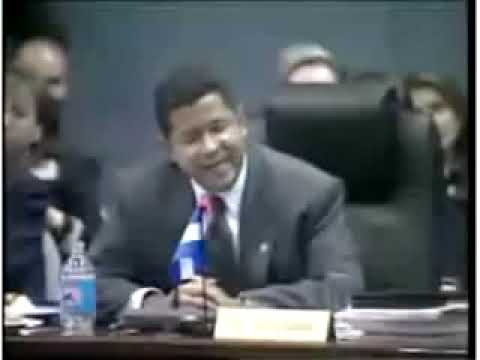
President Francisco Flores took the floor to respond, and his words were unusually direct for a summit where most leaders avoided confronting Castro. He said:
“The delegation that proposed the condemnation of the ETA attacks in Spain was ours, and we did it in solidarity with the Spanish people.
We know what terrorism can do to a society because we suffered many years of war ourselves.
Therefore, Mr. Castro, it is absolutely intolerable that you — involved in the death of so many Salvadorans, you who trained many people to kill Salvadorans — accuse me of being involved with Luis Posada Carriles.”
We will embed the video below. Obviously, the video’s audio is in Spanish, but since it’s a YouTube video, you can enable English subtitles.
It was rare for any Latin-American leader — let alone one from a small Central-American nation — to confront Fidel Castro, a man who had ruled Cuba under a one-party dictatorship for more than four decades.
Over those decades, the Castro family and the Communist Party elite effectively turned Cuba into their own domain.
While ordinary citizens faced shortages, travel restrictions, and censorship, the upper circle of the regime enjoyed exclusive privileges, housing, and access to goods.
Many observers have noted that Cuba became a kind of personal estate run for the benefit of its ruling class, with the Cuban people trapped on an island many dream of escaping.
Meanwhile, Fidel Castro and his relatives accumulated immense personal wealth, even as the government preached socialist equality — a paradox that exposed how socialist and communist ideology served as bait for control rather than liberation.
Castro replied to Flores in his usual combative tone, but the contrast was unmistakable: a young, democratically elected president standing up to one of the hemisphere’s most entrenched authoritarian figures.
While El Salvador had endured its own difficult past, the Cuban dictatorship’s record of political repression, imprisonment of dissidents, and intervention in foreign conflicts — including the training and arming of guerrilla movements during Latin America’s civil wars — was far greater in scale and cost.
The moment did not alter diplomatic relations — in fact, El Salvador and Cuba had no formal ties at the time — but it stood out as a rare, bold exchange in an era when few dared to challenge Fidel Castro in public.
Today, many people are unaware that this confrontation ever happened. Yet it remains a fascinating snapshot of early-2000s Latin-American politics: a tense face-off between two leaders from vastly different generations, witnessed by nearly every president in the region.

Please follow us on X!
Follow @ElSalvadorENx